Free PDF American Babylon: Race and the Struggle for Postwar Oakland (Politics and Society in Modern America)
Do you need new reference to accompany your spare time when being at home? Checking out a publication can be an excellent choice. It could save your time usefully. Besides, by checking out publication, you can enhance your expertise as well as experience. It is not only the science or social knowledge; numerous things can be acquired after checking out a book.
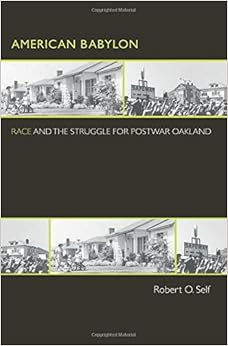
American Babylon: Race and the Struggle for Postwar Oakland (Politics and Society in Modern America)

Free PDF American Babylon: Race and the Struggle for Postwar Oakland (Politics and Society in Modern America)
Exactly what to state and also what to do when mostly your good friends enjoy analysis? Are you the one that don't have such leisure activity? So, it's important for you to begin having that pastime. You know, reviewing is not the force. We make sure that reviewing will certainly lead you to join in much better concept of life. Reading will certainly be a favorable task to do each time. And also do you recognize our buddies become followers of American Babylon: Race And The Struggle For Postwar Oakland (Politics And Society In Modern America) as the most effective book to check out? Yeah, it's neither an obligation neither order. It is the referred publication that will not make you really feel disappointed.
Do you still have no idea with this book? Why should American Babylon: Race And The Struggle For Postwar Oakland (Politics And Society In Modern America) that ends up being the ideas? Everybody has various trouble in the life. But, related to the valid educational and expertise, they will certainly have exact same conclusions, naturally based on facts and research. And currently, how the American Babylon: Race And The Struggle For Postwar Oakland (Politics And Society In Modern America) will certainly supply the presentation concerning exactly what truths to constantly be mind will influent just how some individuals believe and also bear in mind regarding that trouble.
Checking out a book can assist you to open the brand-new world. From knowing nothing to recognizing whatever can be reached when reviewing publications many times. As lots of people claim, more books you read, much more things you need to know, yet couple of points you will certainly feel. Yeah, reading guide will certainly lead your mind to open up minded and constantly try to seek for the various other understanding, also from numerous resources. American Babylon: Race And The Struggle For Postwar Oakland (Politics And Society In Modern America) as a means of just how guide is recommended will be available for you to obtain it.
Consequently, you could take American Babylon: Race And The Struggle For Postwar Oakland (Politics And Society In Modern America) as one of your analysis products today. Even you still have the other book; you can establish your willingness to really get this meaningful publication. It will certainly always offer benefits from some sides. Reading this sort of book additionally will certainly lead you to have more experiences that others have not.
Review
"Winner of the 2005 James A. Rawley Prize, Organization of American Historians""Winner of the 2005 Best Book in Urban Affairs, Urban Affairs Association""Winner of the 2004 Ralph J. Bunche Award, American Political Science Association""Winner of the 2004 Best Book in North American Urban History, Urban History Association""[A]n original and complex explanation for the urban crisis that transformed Oakland, California, from 1945 to 1978. . . . By placing the history of Oakland and its African American community in a new theoretical framework that emphasizes suburban growth, tax revolts, and battles over land, jobs, and political power, Self has challenged historians to reconsider the way that they study postwar black urban communities."---Albert S. Broussard, Journal of American History"[M]eticulously researched. . . . [A] compelling, complex, and original account of black and, to a lesser extent, white community politics in metropolitan Oakland California from 1945 to 1978."---Cynthia Horan, Annals of the American Academy of Political and Social Science"By placing the history of Oakland and its African American community in a new theoretical framework that emphasizes suburban growth, tax revolts, and battles over land, jobs, and political power, Self has challenged historians to reconsider the way that they study postwar black urban communities."---Albert S. Broussard, Journal of American History"If you are concerned with the postwar city, race, economics, and politics, get this book and read it."---Kenneth Durr, American Historical Review"American Babylon traces the dialectic of suburbanization and black power in my hometown of Oakland, California. Encapsulating the postwar history of hundreds of mid-sized American cities, Robert Self's original and fascinating case study historicizes city-suburb racial segregation as a creation within living memory. We cannot heal or make sense of the nation we live in now without American Babylon."--Nell Irvin Painter, Princeton University, author of Southern History across the Color Line"American Babylon promises to be one of those rare works that redefines the field. Robert Self brilliantly weaves together histories that are usually told separately: political economy, labor, black community formation, suburbanization, and civil rights. His analysis of the relationship between 'black power' and 'white power' opens up a new way of thinking about race, economics, and politics in modern America."--Thomas J. Sugrue, University of Pennsylvania, author of The Origins of the Urban Crisis
Read more
From the Publisher
Winner of the 2005 James A. Rawley Prize, Organization of American Historians. Winner of the 2005 Best Book in Urban Affairs, Urban Affairs Association. Winner of 2004 Ralph J. Bunche Award, American Political Science Association Winner of 2004 Best Book in North American Urban History, Urban History Association
Read more
See all Editorial Reviews
Product details
Series: Politics and Society in Modern America (Book 37)
Paperback: 408 pages
Publisher: Princeton University Press; Revised edition (August 28, 2005)
Language: English
ISBN-10: 0691124868
ISBN-13: 978-0691124865
Product Dimensions:
6 x 1.5 x 9 inches
Shipping Weight: 1.2 pounds (View shipping rates and policies)
Average Customer Review:
4.2 out of 5 stars
8 customer reviews
Amazon Best Sellers Rank:
#291,480 in Books (See Top 100 in Books)
This book is a fascinating looking at the growth of Oakland's suburbs, the problems that brought to Oakland proper, and how everybody responded. It has a wealth of detail, is extremely well-researched, and is an easy read.
An interesting presentation. Unfortunately, for me, the author's acceptance and presentation sour the overall power of his text. That there was institutional racism I do not argue, but that the Unions and communist/marxist groups were portrayed as 'supporting' the black causes without criticism or context leaves me less comfortable. Oakland is home and includes the majority of the period of the book. Recommended for reading, but with a fore-warning on perspective.
Pretty good condition. Fast shipping. (: Had oil marks on the cover but it's ok.
perfect condition
In American Babylon, Robert Self attempts to synthesize consistently isolated renderings of urban, suburban, white black, economic and sociocultural histories in postwar metropolitan development. He seeks to join the histories of "modernist city planning" with "politics and social struggle (9)." In doing so, he centers his study around three primary transitions, each roughly beginning in the New Deal era and reaching completion around the advent of Johnson's Great Society. First, the remaking the white labor movement into what he terms "conservative populism." Second, the remaking of progressive black labor and urban activism into black militarism, nationalism, and Maoism. Finally, the remaking of liberal state aid from infrastructure development to human development, from direct financial subsidy for low-income whites to mobilization against pathology for low-income blacks.The study concludes with a clash between the liberal state and suburban prosperity, newly estranged by the racialized nature of poverty.Key to the suburban backlash of the seventies is a political disposition that formed much earlier in the late forties called "conservative populism." Self defines "conservative populism" as a postwar coalition of white blue collar workers, skilled workers, and small business interests that were pro-union, pro-private property, pro private-rights, anti-tax and anti-big-business. He defines "industrial garden" as a sort of ecosystem of commercial, industrial, and residential infrastructure in close proximity that delivers abundance and utopian living. Upon the failure of the inner city industrial garden to deliver utopian prosperity, suburbs became the actualized vision of the garden city and the staging grounds for an evacuation of prosperity.Self portrays 1960s urban spaces as a conflict between business elites who wish to mechanize and deindustrialize infrastructure toward the end of capital accumulation, and blacks who want infrastructure investment in neighborhoods. Sometimes I found myself asking if Self was too adherent to municipal boundaries in drawing the border between city and suburb. It seems to me that large parts of American cities became and remained suburban-like in the postwar era. To use my own city as an example, there are places where Minneapolis and its suburbs seem to be very much of the same yoke. I wonder to what degree this is the case with Oakland?There are times when the text seemed aggressive in reducing the city playing field to a contest between business infrastructure and poor blacks when a significant number of prosperous white residents remained in the city. I wonder if "post-municipalism" would be a useful younger sibling to "post-nationalism" in conceptualizing urban spaces. It might be rhetorically useful if "suburb" was reduced to an adjective in a study like this.American Babylon hits its stride as it explores and lucidly articulates the reasons behind the conservative backlash and the death of the welfare state. While there is a tremendous body of scholarship that presents cultural explanations for the conservative backlash, it is rare that one finds an economic explanation, especially one that centers prosperity rather than exploitation and false consciousness (a la Thomas Frank) as its driving phenomenon. Self takes the same statistics that others (like George Lipsitz) have used to document the structural invention of black poverty and animates them as a call to action for white tax activists.In affirming that both disempowerment and empowerment can be the precursors of fervent activism, Self avoids reinscribing social action as an exotic and racialized mystique of nature. Undisturbed by the proscribed boundaries of most scholarship, such mystique holds that liberal activism is essentially black, essentially urban, and essentially anti-capital or that conservative activism is essentially white, essentially rural, and essentially theological. Self disturbs and hybridizes this binary by locating the most demonstrably effective social action within suburbs.Self also uses the suburbs to disrupt what he sees as an inadequate north/south binary in Afro-American history. It is not just business that opposes the welfare state for being anti-market or whites that oppose it out of racism, as one might gather from prevailing readings of the southern movement. Suburban whites had a vested economic interest in the elimination of civil rights gains and their adjunct, the liberal welfare state. Self also advocates retelling the civil rights movement as a national black confrontation with the exclusionary policies of the New Deal.In perhaps his most radical departure from existing scholarship, Self talks about political economy without talking about liberal capital or economic determinism. He does not see lopsided urban development as the problem or manifest destiny of a free market, nor does he see policy as a reliable proscription on the lives of people. For Self, capital success is always prefixed by organized social action. The invisible hand is neither anonymous nor autonomous and Self is on a mission to name names.Yet American Babylon is not without shortcomings. The introduction seems to be seeping with rich and critical contradictions. But the text-and perhaps it is just an artifact of the massive amount of information that is represented-the prose engages most of its terms with a very declarative nonchalance. A writer of similar style would be Nell Irvin Painter. Self's prose has a disarming factuality that marginalizes the ambiguity and contested meaning which seems central in cultural history. For all of its insights, it is difficult to read American Babylon as a cultural history because it is so linear. Because it does not raise problematics or invoke dialectic to resolve unclear and confounding juxtapositions, its engagement with its data is more encyclopedic than exegetical.Ironically, while the Self does not talk about hegemony, intersectional theory, Foucault, Marx, modernity, or subjectivity, his work offers a framework for dissent that could not be built within the cultural studies lexicon.
Why did it surprise me to learn that San Leandro, a suburb of Oakland CA, was a white only town? Or that the Federal Housing Authority born of the New Deal thirties expressly disallowed lending in black urban areas? Or that post WII federal subsidized loans went primarily to white families moving into protected enclaves that expressly disallowed blacks?Because my own white privilege makes it difficult to face the uncomfortable truth that I and my kind have inherited, protected and extended the advantages of our racial makeup. Or in a word: denial.This book argues very persuasively that white access and understanding of capital allowed and extended privilege through political power and government policy in a way that often avoid the clear label of racism. And until the seventies racial covenants and red-lining black neighborhoods expressly deprived black people of the means for a better life.With blacks struggling for fair housing, fair employment and fair political representation, white America through the welfare state it denies exists, gave itself huge subsidies for cheap loans and job programs to build highways and other infrastructure projects that unions made sure its white members enjoyed.I'm painting too broad a portrait because what makes this book particularly powerful is that it uses the particulars of the Oakland experience to reveal the attitudes, behaviors and policies described above. If you're white don't read this book unless you are prepared to be unsettled and disturbed. If you're not white, I doubt much of this will surprise you but be prepared to get angry all the same.
Robert Self's "American Babylon: Race and the Struggle for Postwar Oakland" deserves the attention of grassroots political activists as much as academics. It is a brilliant analysis of the post-World War Two business strategy for Oakland, California and the boom (and boomerang to Oakland) in housing and jobs elsewhere in Alameda County that resulted. Self shows how the decline of Oakland was the other side of the coin in the creation of new communities in the open spaces nearby. He lays out the class and race contexts of the suburbanization process and shows the consequences for and responses by the labor movement and African Americans to the changes that were wrought. "American Babylon" thus provides, for example, an interesting account of the Black Panther Party. Finally, using this region in northern California as a case study, the book examines the origins of the anti-property tax movement, when the suburbs regime went sour. Since California is still embroiled over the same issues this book addresses -- taxes, urban revitalization, de-industrialization, racial equality, and the political and environmental impacts of suburban growth -- Robert Self's "American Babylon" could not be more timely.
American Babylon: Race and the Struggle for Postwar Oakland (Politics and Society in Modern America) PDF
American Babylon: Race and the Struggle for Postwar Oakland (Politics and Society in Modern America) EPub
American Babylon: Race and the Struggle for Postwar Oakland (Politics and Society in Modern America) Doc
American Babylon: Race and the Struggle for Postwar Oakland (Politics and Society in Modern America) iBooks
American Babylon: Race and the Struggle for Postwar Oakland (Politics and Society in Modern America) rtf
American Babylon: Race and the Struggle for Postwar Oakland (Politics and Society in Modern America) Mobipocket
American Babylon: Race and the Struggle for Postwar Oakland (Politics and Society in Modern America) Kindle
0 komentar:
Posting Komentar