PDF Download Khubilai Khan: His Life and Times, by Morris Rossabi
Are you interested? Simply discover the book now and also get exactly what you call as ideas. Inspirations can feature various topics as well as systems. The knowledge, experience, facts, as well as enjoyment will become parts of the inspirations. This publication, Khubilai Khan: His Life And Times, By Morris Rossabi, has that great ideas that the writer makes to remind you about guide material. It also features the outstanding functions of a publication to obtain while in every reading state.
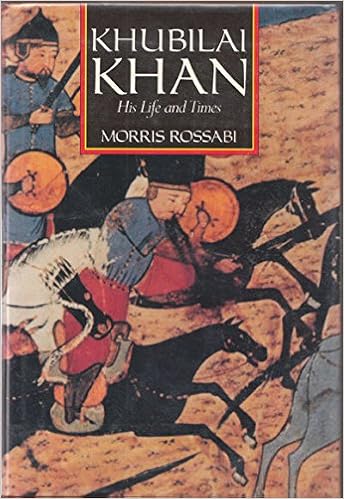
Khubilai Khan: His Life and Times, by Morris Rossabi

PDF Download Khubilai Khan: His Life and Times, by Morris Rossabi
Khubilai Khan: His Life And Times, By Morris Rossabi. Modification your practice to put up or waste the time to just talk with your good friends. It is done by your everyday, do not you really feel bored? Now, we will certainly show you the extra habit that, really it's a very old behavior to do that could make your life more certified. When really feeling tired of always chatting with your good friends all spare time, you could discover guide entitle Khubilai Khan: His Life And Times, By Morris Rossabi and afterwards read it.
Now this book is presented for you the book lovers. Or are you not type of publication enthusiast? Never mind, you can additionally read this publication as others. This is not sort of obligated book to refer for sure neighborhood. But, this book is additionally referred for everyone. As recognized, every person could obtain the advancements as well as understanding from all book kinds. It will depend upon the individual taste and should review certain book. And also once again, Khubilai Khan: His Life And Times, By Morris Rossabi will be available for you to obtain that you want and needs.
When intending to have such experience, checking out a publication will certainly be likewise the support in you doing that act. You could start from gathering the ideas first and getting the impression of the activities. In addition this Khubilai Khan: His Life And Times, By Morris Rossabi can assist you to boost the expertise of just what you have actually not known related to exactly what you will do now. Reading it might be done detailed by checking out page by web page. It will not constantly remain in the short time to complete this publication.
When you need to know again just how the discussion of this publication, you need to get it as quicker. Why? Be first individuals that have Khubilai Khan: His Life And Times, By Morris Rossabi in soft file type now. It originates from the charitable publisher and also library. When you intend to get it, see its web link and established it. You can also discover even more boo collections in our website. All is in the soft data to check out easily as well as promptly. This is what you could obtain minimally from this publication.
From Library Journal
In this highly readable biography Rossabi confines himself to historical sources to provide a fascinating life of this great ruler. Although Khubilai acquired the title of Great Khan, the Mongol empire of the 1250s already had broken into four segments, with Khubilai ruling North China. His greatest success came when he was over 60 with the conquest of the southern Sung dynasty. In the last years of his life, however, he suffered from personal tragedies, obesity, alcoholism, and military reverses. Still, Khubilai ruled "the largest and most populous empire in the history of the world until that time." Recommended for most libraries. History Book Club main selection. David D. Buck, Univ. of Wisconsin - MilwaukeeCopyright 1988 Reed Business Information, Inc.
Read more
Product details
Hardcover: 322 pages
Publisher: Univ of California Pr; First Edition edition (May 1, 1988)
Language: English
ISBN-10: 0520059131
ISBN-13: 978-0520059139
Package Dimensions:
9.3 x 6.5 x 1.2 inches
Shipping Weight: 1.2 pounds (View shipping rates and policies)
Average Customer Review:
3.7 out of 5 stars
8 customer reviews
Amazon Best Sellers Rank:
#173,339 in Books (See Top 100 in Books)
Review of Rossabi’s "Khubilai Khan" by Paul F. Ross A movie reminded this reader that he knew essentially nothing about the Mongols and their dominance across the northern land mass now known as Europe and Asia. Thinking Chinggis (Genghis) Kahn was the most successful, I searched for a biography. However I failed to make the distinction between Chinggis (1162-1227, early leader uniting Mongol power) and Khubilai (1215-1294, Chinggis’____________________________________________________________________________________Rossabi, Morris "Khublai Khan: His life and times" 1988, University of California Press, Berkeley CA, xvii + 323 pages____________________________________________________________________________________grandson and the Khan that ruled over the largest territory). Thinking I was buying a biography of Chinggis, I actually bought a biography of Khubilai. I had much to learn. Among other things, I relearned that Marco Polo made his trip from Venice, Italy, to China in about 1272 and, among many other things, visited the court of Khubilai Khan in Ta Tu. Nicolo and Maffeo Polo reached Khubilai Khan’s court in about 1265 or 1266. The Polos knew a good trading mission when they saw one. Morris Rossabi, author of this history of Khubilai Khan, taught Chinese history at Case Western Reserve University in Cleveland and the China Institute, Columbia University, and Queens College in New York. Rossabi and all other historians seeking to review the history of the Khans face a difficult task. The Mongols had no written language. So there are no histories of the Mongols written by the Mongols. The sources available to the historians are Confucian Chinese, Muslim Persians, and Shinto Japanese, and Nestorian Christians … primarily the first two … and the Confucian Chinese of the Southern Sung dynasty were the largest and most advanced population conquered by Khubilai. These several sources were recorded with points of view held by peoples subjugated by the Mongols. The sources differed in their descriptions of the Mongols and their governance. Rossabi reports that Khubilai was relatively even handed in supporting all of the cultures coming under his rule, supporting their religions, avoiding extensive damage to their economies, carefully avoiding imposition of the nomadic hunting-gathering economy of the Mongols on the agriculturists in the Chinese economies, respecting many of the Chinese governing traditions, actively seeking to build the economies of the conquered peoples (thus allowing the collection of more taxes), supplying food and other support such as tax relief when disasters (such as drought) struck, supporting their arts. As in ruling families worldwide, Khubilai had to cope with a few relatives who led rebellions against Khubilai as well as some rebellions among the conquered peoples. Khubilai was elected the Great Khan (ruler of the Mongols) in 1260 and held that role until his death in 1294. Khubilai’s reign in China was designated the Yuan dynasty in Chinese history and it concluded in 1368, less than seventy five years after Khubilai’s death. Rossabi seeks to present a broad sweep of Khubilai’s times by telling the military stories, Khubilai’s governance stories as Rossabi sought to balance competing political forces, stories about collecting taxes, stories describing the theater, stories describing Khubilai’s efforts to create a written language for the Mongols, and so on. Rossabi struggles with his diverse sources and their conflicting points of view, frequently warning the reader that his description is a guess, he having tried to weigh the differing points of view of his sources and report what Rossabi regards as the likely truth. One can get another look at the Yuan dynasty through the eyes of Fairbank and Goldman (1998, p 119-142) as the Mongol rule under Khubilai Khan is embedded by these historians in their history of China. It is a brief report, twenty three pages, in a 500+ page history of China. “The Mongols were despised … and Mongol rule lasted less than a century, more brief than Ruzhen rule had been in North China. Except along the Great Wall the Mongols could not take root (p 122),†Fairbank and Goldman write. The difference between a history written with Rossabi’s sources from 800 years ago and current history or biography is enormous. With many sources including people who experienced the events, histories describing recent events are very much more satisfying than this history of a people who had no written language. For current standards, see Bernanke’s account (2015) of the 2007-2009 worldwide economic recession and the efforts to recover. See Canellos and colleagues (2009) describing the life of Teddy Kennedy. Davies (1996) views the history of Europe over a long timeline and his history has little to say about the Mongols’ invasion by Chinggis Khan. History, one must judge, is always a set of events sifted by the values of the historian and the richness and perspectives of the sources. Rossabi’s history of Khubilai Khan has the marks of careful workmanship, given the sources available to him. Rossabi organizes his topics into chapters, opens by telling you what he’s going to tell you, then tells you, and finally summarizes what he’s told you. Some of Rossabi’s generalizations about Khubilai are repeated many, many times. However my ignorance of the Mongols and their history was stark and my knowledge of Chinese history was very sketchy. So long as memory sustains what I’ve learned, that ignorance has been pushed away in at least some areas by this read of Rossabi’s history of Khublai Khan.Bellevue, Washington19 November 2015Copyright © 2015 by Paul F. Ross. All rights reserved.ReferencesBernanke, Ben S. The courage to act: A memoir of a crisis and its aftermath 2015, W. W. Norton & Company, New York NYCanellos, Peter S. (Editor) Last lion: The fall and rise of Ted Kennedy 2009, Simon & Schuster, New York NYDavies, Norman Europe: a history 1996, Harper Perennial, New York NYFairbank, John King, and Goldman, Merle China: A new history Enlarged Edition. 1998, Harvard University Press, Cambridge MARossabi, Morris Khublai Khan: His life and times 1988, University of California Press, Berkeley CA
excellent source, reliable and thorough, parts are naturally better suited for asian or history majors text is actually 230 pages with about 95 pages of cite materialdelivers a very clear picture of the development and influence kubilai and mongolian culture had on 13th century asia, because of the balancing act that kubilai was responsible for, there is a near pleading for the reader to indulge other aspects of this time because kubilai is such a dense figure and the mongols such a volatile despotism that despite the density of sources it feels like wisps of information that reveal both a cunning and touching glimpse of poweri would like to read about genghis and chiang kai-shek, if the same author has tackled other asiatic dynastic figures i can only hope they would be as well crafted, fully satisfied
If you have ever been interested in learning about the amazing Khubilia Khan or the Mongols this is the book to read.Morris Rossabi knows his stuff and it that is clearly evident in this book.Rossabi does a great job explaining the man Marco Polo met in China. Rossabi does a great job explaining the Mongols, their Empire, and their leader Khubilia Khan.I highly recommend this book to anyone interested in learning about one of the largest empires to ever exist and their amazing leader.It is great to read a book written by someone who knows his stuff. Rossabi knows his stuff!
Great book
OK, so maybe Morris Rossabi was right not to speak of this great Khan as "a most excellent barbarian" as if he emerged from some "sandal and Vandal" Hollywood epic. But, this historical figure lived amidst some of the most colorful, interesting times (not to mention extremely bloody ones). A little more pizzazz could have livened up the biography of an undoubtedly important character in world history. Rossabi's book is competent, it is scholarly, it is well-organized, it is impressively wide-reaching in its use of English, French, German, Italian, Russian, Chinese, and Japanese sources (and the author seems to have some knowledge of Mongol and Tibetan too). Nobody could fault such a book for incompleteness. Certainly I am not qualified to spot any inaccuracies. We learn the antecedents of Khubilai Khan, how he emerged from the welter of contestants for the top job, how he organized the bureaucracy, picked his advisors, dealt with the various religions and their factions, how he conquered the Southern Sung (rulers of 50 million Chinese), how he became a patron of the arts, and how he tried and failed to conquer Burma, Vietnam, and Japan. On finishing the book, I felt sure that I had read most of the available information on Khubilai Khan. But....I would have liked some insights, which I believe Dr. Rossabi could have provided. Where can we place Khubilai Khan in the long history of struggle between nomad and sedentary farmer in North Asia ? How did he stack up against previous and later rulers ? What were the results of the various policies he followed and were they very different from what the Chinese had done ? And ? Well, I might not be able to come up with many more possible themes like this, but I would have enjoyed some questions and answers, to be shown a broader picture.Still, if you need a book on the life of Khubilai Khan which is clearly written and avoids jargon---though the author does tend to insert a few too many Mongol and Chinese terms which are useless to lay readers---you could do worse than obtain this volume, probably the premier work on the subject in English.
Khubilai Khan: His Life and Times, by Morris Rossabi PDF
Khubilai Khan: His Life and Times, by Morris Rossabi EPub
Khubilai Khan: His Life and Times, by Morris Rossabi Doc
Khubilai Khan: His Life and Times, by Morris Rossabi iBooks
Khubilai Khan: His Life and Times, by Morris Rossabi rtf
Khubilai Khan: His Life and Times, by Morris Rossabi Mobipocket
Khubilai Khan: His Life and Times, by Morris Rossabi Kindle
0 komentar:
Posting Komentar